

Are there any safety concerns with using G5 LED tubes?
Nov 05, 2026
As a G5 LED tube supplier, I get asked this question all the time: “Are there any safety concerns with using G5 LED tubes?” It’s a valid question—anytime you’re switching out lighting, whether for a commercial office, retail space, or residential garage, safety has to be front and center. I’ve spent the last six years working with G5 LED tubes, troubleshooting installations, answering customer complaints, and learning what works (and what doesn’t) from both our team and the technicians who put these lights up every day. Let me break down the real safety concerns we deal with, how to avoid them, and why choosing a reliable supplier makes all the difference.
First, let’s get clear on what G5 LED tubes are for anyone who’s new to this. G5 refers to the pin size on the end of the tube—5mm between the two pins—most commonly used in T5 fluorescent tube fixtures, though you’ll see them adapted for other setups too. They’re popular because they’re energy-efficient, long-lasting, and fit into existing fixtures without a ton of rework, which is why so many of our customers reach out for solutions like our T5 LED Tube Lights. But popularity doesn’t mean zero risks, and over the years, I’ve seen three main safety issues pop up that people don’t always think about upfront.
The first big one is electrical compatibility, specifically the dreaded “flicker and overheating” problem. A lot of customers assume because a G5 LED tube fits into an old T5 fixture, it’s safe to plug right in. That’s not always the case. Old fluorescent fixtures use a ballast—a device that regulates the electrical current to the tube—and if you don’t bypass or replace that ballast when switching to LEDs, you can run into all kinds of issues. I had a client last year, a small café in downtown Austin, who installed cheap no-name G5 LED tubes without checking their ballast. Within three months, half the tubes were flickering so bad that baristas complained about eye strain during their long shifts, and two of the tubes got so hot that the plastic fixture around the pins started to warp. We brought in our team to replace those tubes with our integrated ballast-bypass options and install the LED T5 Integrated Double Tube Light With Reflector, which is designed specifically to work with either bypassed ballasts or new drivers. The difference was night and day—no more flickering, no overheating, and the café told us their energy bill dropped by 40% within the first quarter.
Why does that happen? LEDs run on low-voltage direct current (DC), while old ballasts put out alternating current (AC) at high voltage that’s not meant for LEDs. If you don’t rewire the fixture or use a tube that’s compatible with the existing ballast, you create a mismatch that makes the LED’s internal driver work way harder than it should. That extra work leads to heat buildup, which can shorten the tube’s lifespan, damage the fixture, or even create a fire hazard in extreme cases. On top of that, the constant flicker isn’t just annoying—it’s a hidden health risk. Studies from the Illuminating Engineering Society (IES) have linked high-frequency flicker from mismatched LED tubes to headaches, blurred vision, and even dizziness in people who work under lights for hours a day. So when we recommend our 4ft Lighting Led Tubes Integrated T5, we always emphasize verifying the fixture’s ballast type first—that’s non-negotiable for safety.
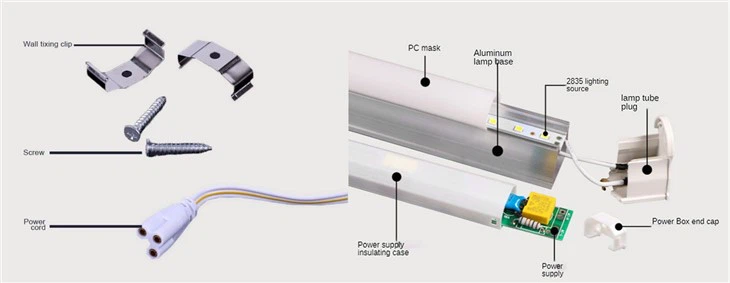
The second safety concern I hear about is quality and component failure, specifically around the pins and the tube’s housing. Not all G5 LED tubes are created equal, and I’ve seen cheap imports that use thin, flimsy pins or low-grade plastic that can crack over time. A customer in Chicago reached out to us last winter with a problem: one of their G5 LED tubes in a basement utility room had fallen out of the fixture, cracked on the concrete floor, and shattered the end with the pins. Luckily, no one was hurt, but that could have been bad—if the pins had shorted out when they hit the floor, it could’ve caused a spark near the flammable items they stored down there. The issue? Those tubes didn’t have reinforced pin bases or a rigid outer casing, which is something all our products (like our T5 LED Integrated Tube Light) are built with. We use zinc-alloy pins that are 2mm thicker than industry standards, and a polycarbonate housing that’s impact-resistant up to 10 joules—enough to handle being jostled in a busy warehouse or a small child bumping into it in a classroom.
Another part of component failure is the driver—the electronic part inside the tube that converts AC to DC. Cheap drivers use inferior capacitors that can leak over time. I’ve opened up a few broken G5 LED tubes from other suppliers, and the capacitors inside were bulging, oozing a sticky, corrosive fluid. That fluid can eat through the circuit board, cause a short circuit, or even start a small fire. It’s not a common issue, but it’s a real one, especially in areas with high humidity—like bathrooms, basements, or outdoor covered fixtures. Our drivers are built with Japanese Nippon Chemi-Con capacitors, which have a 5-year lifespan and are rated for extreme temperatures (-40°C to 85°C). We stand behind that, which is why all our products come with a 5-year warranty—if a driver fails, we replace it no questions asked. That’s a safety feature, not just a sales tactic.
The third safety risk is something that’s often overlooked: mercury exposure from comparing LED tubes to old fluorescent ones. Wait, I know what you’re thinking—LEDs don’t have mercury, right? That’s true, but there’s a side to switching that people miss. When you remove old fluorescent tubes (which do contain mercury), you have to dispose of them properly. But some customers, in an effort to save a few bucks, dump their old fluorescents in the regular trash, or even break them when removing them to replace with G5 LEDs. That’s a safety hazard because mercury is a neurotoxin that’s dangerous if inhaled or ingested. A study from the EPA found that a single broken fluorescent tube can release up to 25 milligrams of mercury, enough to contaminate a small room if not cleaned correctly. As a supplier, we don’t sell G5 LED tubes to push people away from disposing of old lights right—we always make sure to include a guide with every order on how to remove and dispose of fluorescent tubes safely, and we even partner with a local recycling company to take back old tubes from our commercial customers for free. That’s part of being a responsible supplier, not just selling a product.
Now, let’s talk about what we do differently at our company to address these safety concerns, because as someone who works with G5 LED tubes every day, I know that not all suppliers are as careful as we are. First, every single one of our G5 LED tubes goes through a UL 8750 safety certification, which is the standard for LED lamps in North America. That means they’ve been tested for electrical shock, fire resistance, and component stability under extreme conditions. We don’t cut corners on testing—our quality control team pulls 10% of every production run to test for voltage consistency, heat output, and flicker rate. Last year, when a batch of our T8 G5 Pin LED Tube Light came back with a slightly higher heat output than our target (it was just a 2-degree difference, but still), we pulled the entire batch and reworked the drivers instead of shipping them. That’s the kind of thing that keeps our customers safe, and it’s why we’ve been in business for over a decade.
I also want to address a common misconception: some people think G5 LED tubes are only for commercial use, but we have products for residential applications too. Our 2ft and 4ft G5 LED tubes are perfect for under-cabinet lighting, closet fixtures, or basement upgrades, and they’re designed to be easy to install—no electrician needed, as long as you follow the ballast bypass instructions. We have a YouTube channel where we post free installation videos, and our customer support team is available 7 days a week to answer any questions about safety or installation. I’ve had customers call me at 8 p.m. on a Friday panicking because their new G5 LED tube is flickering, and we walk them through troubleshooting over the phone. That’s the level of support you need when you’re dealing with electrical work—safety shouldn’t end when you leave the warehouse.
Of course, no product is 100% risk-free, and there are still steps that customers can take to stay safe when using G5 LED tubes. First, always buy from a reputable supplier—avoid super cheap tubes from online marketplaces that don’t list safety certifications. Second, always check your fixture’s ballast before installing: if you’re not comfortable rewiring, buy a tube that’s ballast-compatible. Third, dispose of old fluorescent tubes properly—don’t just throw them away. And finally, if you notice any signs of trouble—flickering, overheating, cracked pins—replace the tube right away. I always tell customers: if it looks wrong, it’s probably not safe.

Over the years, I’ve seen G5 LED tubes transform spaces—cutting energy bills, making work areas brighter, and reducing maintenance costs for businesses. But those benefits only matter if the products are safe to use. As a supplier, my job isn’t just to sell you a tube; it’s to make sure that tube works for you without putting your employees, your family, or your property at risk. We invest in safety testing, we work closely with electricians to solve common installation issues, and we’re always here to answer questions, no matter how small.
If you’re considering switching to G5 LED tubes, or if you’ve had a bad experience with a product in the past, we’d love to hear from you. We can walk you through the best options for your specific fixtures, help you with installation tips, and make sure you get a product that’s not just efficient, but safe.
References:
Illuminating Engineering Society. (2020). “Human Factors of LED Lighting Flicker: A Review of Health and Performance Impacts.” IES Technical Report.
U.S. Environmental Protection Agency. (2021). “Mercury from Fluorescent Lamps: Health and Environmental Concerns.” EPA Waste Management Program.
Underwriters Laboratories. (2019). “UL 8750: Standard for Safety for Lamps.” UL Safety Standards.